
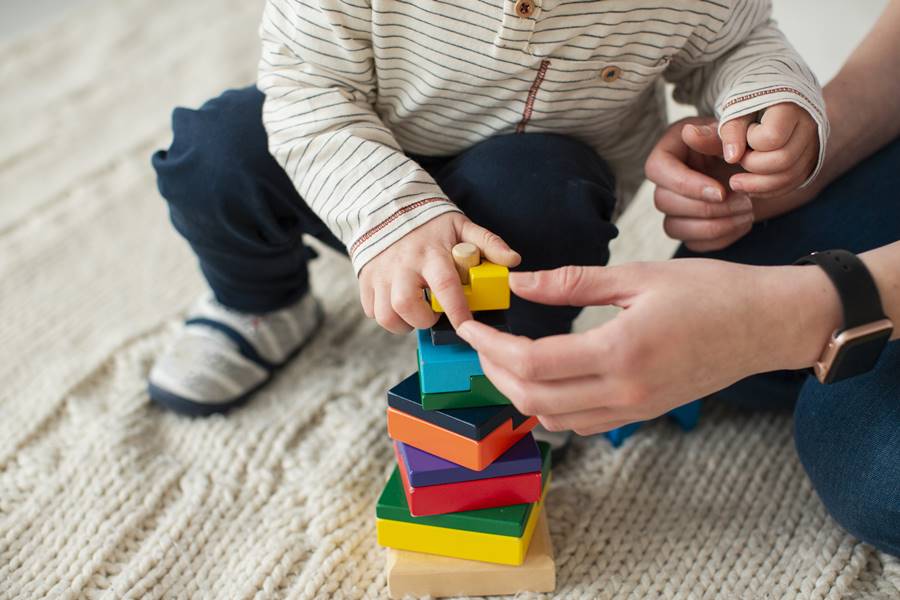
The game is a central aspect during childhood. In fact, a child’s overall development is inseparable from play, especially from being able to play freely. Children learn through playing. The more they play, the more and faster they learn. But we shouldn’t be too demanding. We must not think of play as a means to an end. Play is and should be an end in itself.
Starting to crawl
We should give children the opportunity to pick up their own toys. Simply trying to grab a toy is already play for them and helps increase their autonomy by making intentional movements. They also learn to think of alternative ways to achieve their goal. Once they can sit up steadily, it is good for them to play with balls and objects they can throw or roll. This encourages them to throw things and then go get them, realizing that things that go away can be retrieved. These kinds of games will ease separation when your child goes to daycare, etc. It can be encouraged with other games like covering and uncovering objects with cloths, helping children understand that what is covered doesn’t disappear but remains.
Around one year
Around one year old, their desire to stand up will be unstoppable. We must watch that the environment around our children does not pose dangers, as they will fall frequently. We should be especially careful with corners and unstable objects. The safer the environment feels to them, the more they will explore. However, it’s not advisable to empty the space completely, as it should be attractive and have objects within reach so they can experiment freely. If we see they struggle to start walking, we can move the furniture apart a bit to encourage them to take a few steps.
From one year on, the child moves around, crawls, and starts walking. They are very active and have incredible energy. They have also learned to grab things, throw them to the floor, change hands, and keep learning more and more. Their interest in the surrounding world grows rapidly and play possibilities become many. Sensory and physical games remain very fun for them, but we will need to make them a bit more complex and add a touch of creativity.
Imitation: a thousand ways to play
Between 1 and 2 years, the baby discovers something wonderful: the ability to imitate parents and others around them, leading to a new way of playing that gradually introduces them to the adult world. We will see them grab any object to pretend they are talking on the phone with grandma, imitate animal sounds we taught them ("What does the dog say?", "And the kitty?"), touch their nose or eyes when asked "Where is your nose?", dance to any tune they hear, feed us with a spoon, climb on a stool to look in the bathroom mirror and pretend to comb their hair, or drive a toy car while sitting on the couch. And all this they learn on their own by watching and imitating us. Imitation is a very important factor in learning and acquiring new knowledge.
Crafts
Origami, for example, is not only an art practiced by adults but also by children. In the 19th century, it was introduced into Japanese school education by Friedrich Fröebel to teach geometric shapes. Nowadays, colorful paper is used to make it more attractive for children. Among the many benefits of practicing origami are:
• Encourages imagination and artistic expression: once the child knows basic concepts, they can create their own designs, bringing their ideas to paper.
• Builds self-esteem: the child sees an idea realized and feels accomplished, besides receiving praise for their achievements.
• Develops manual dexterity and improves attention: the folds need to be exact and precise, maximizing attention and concentration. It exercises the hands, massages the fingers, and supports fine motor coordination.
• Develops patience and perseverance: a design will not turn out well the first time; it improves gradually with much practice.
• Strengthens: memory, imagination, and thinking.
• Accelerates brain maturation and better intellectual performance in the future: due to coordination exercise of hands and fingers, it is active mental work, attention, and a natural finger massage that stimulates brain activation.
• The required concentration helps children distract their minds from stress, obsessions, and fears; when doing origami, they forget everything. It is even used with children who have emotional problems.
• It is a healthy moment of relaxation and fun.
The brands Beybies, Pura+, and NrgyBlast belong to Avimex de Colombia SAS. All products have valid quality certifications and sanitary registrations and are manufactured under the strictest international standards. To acquire our products, you can access our Online Shop. All purchases are backed by a 100% satisfaction or money-back guarantee.